:::
北醫大Lucas A. Lane助理教授團隊突破傳統光學檢測瓶頸 攜手國際研究生創新奈米塗層技術 點亮癌症早期診斷曙光
臺北醫學大學醫學工程學院「生物醫學工程國際博士學位學程」Lucas A. Lane助理教授團隊取得重大醫學工程突破 !其探討推進疾病早期診斷的前沿研究,正式發表於膠體與界面科學領域頂尖國際期刊《Advances in Colloid and Interface Science》(Advances in Colloid and Interface Science, Journal Impact Factor:19.3)。此項高影響力成果展現了北醫大傑出的國際科研培育,由Lucas A. Lane教授指導的兩位優秀國際學生——來自印尼且即將從奈米醫學工程研究所畢業的碩士生 Maria Lucia Veronica Theja(Lucia),以及就讀於「歐亞醫療技術與醫療保健商務雙碩士(EMMaH)」學程並隸屬「生醫光機電研究所」的交換生 Maud Gacquer,共同展現堅韌毅力投入研究,並擔綱論文的核心撰寫工作 。
該研究指出,透過創新設計「表面增強拉曼散射(SERS)奈米標籤」的保護外層,能大幅顛覆傳統檢測極限 。臨床上,傳統依賴螢光染料的光學技術面臨褪色快、難以多目標追蹤及近紅外光(NIR)訊號微弱等瓶頸。結合奈米科技與光譜學的 SERS 奈米標籤雖具備高光穩定性及強烈近紅外光訊號,但過去多偏重優化金屬核心,忽略了核心外保護層的重要性 。
Lucas A. Lane教授師生團隊的研究首度系統性證實,這層過去被忽視的「保護外層」才是決定探針膠體穩定性、標靶專一性以及訊號亮度的絕對關鍵 。團隊透過優化特殊高分子(如 AMP 聚合物)與生物膜(如紅血球膜)的塗層架構 ,精準導向靶心,成功將生物標記的檢測極限推進至極低的「阿托莫耳(attomolar)」層級 。這項兼具高靈敏度與高專一性的醫工創新成果,未來將轉化為更精準的臨床早期檢測工具,全面提升多重標靶篩檢效能 。
TMU Assistant Professor Lucas Lane’s Team Breaks Optical Detection Limits; International Graduate Students Co-Author Innovative SERS Nanotag Research for Early Cancer Diagnostics
A major biomedical engineering breakthrough has been achieved by the research team led by Assistant Professor Lucas A. Lane from the International Ph.D. Program in Biomedical Engineering, College of Biomedical Engineering at Taipei Medical University (TMU)! Their pioneering review on advancing early disease diagnosis has been officially published in the prestigious international journal Advances in Colloid and Interface Science (Advances in Colloid and Interface Science, Journal Impact Factor:19.3). This high-impact accomplishment highlights TMU's exceptional international research collaboration, made possible through the determination and hard work of Professor Lane's students: Maria Lucia Veronica Theja (Lucia), a soon-to-graduate master's student from Indonesia at the Graduate Institute of Nanomedicine and Medical Engineering ; and Maud Gacquer, a student in the Euro-Asian Master in Medical Technology and Healthcare Business (EMMaH) program affiliated with the Graduate Institute of Biomedical Optomechatronics. Both international students served as critical driving forces behind the formulation and writing of this study.
The study reveals that rationally engineering the protective surface coatings of Surface-Enhanced Raman Scattering (SERS) nanotags can significantly surpass current diagnostic boundaries, paving the way for ultrasensitive early detection of cancer biomarkers and viruses. Clinically, conventional optical techniques relying on fluorescent dyes suffer from rapid photobleaching, low multiplexing capabilities, and weak signals in the biologically transparent near-infrared (NIR) window.
Professor Lane's team is the first to comprehensively demonstrate that these underemphasized surface coatings are key determinants of probe stability, biological targeting specificity, and signal brightness. By precisely customizing advanced polymer linkers (such as AMP polymers) or biomimetic coatings (such as red blood cell membranes) , the engineered coatings form a superior barrier that prevents particle aggregation while pushing detection limits down to the unprecedented attomolar level. The successful implementation of this innovative architecture promises to translate into high-precision, multiplexed clinical diagnostics.
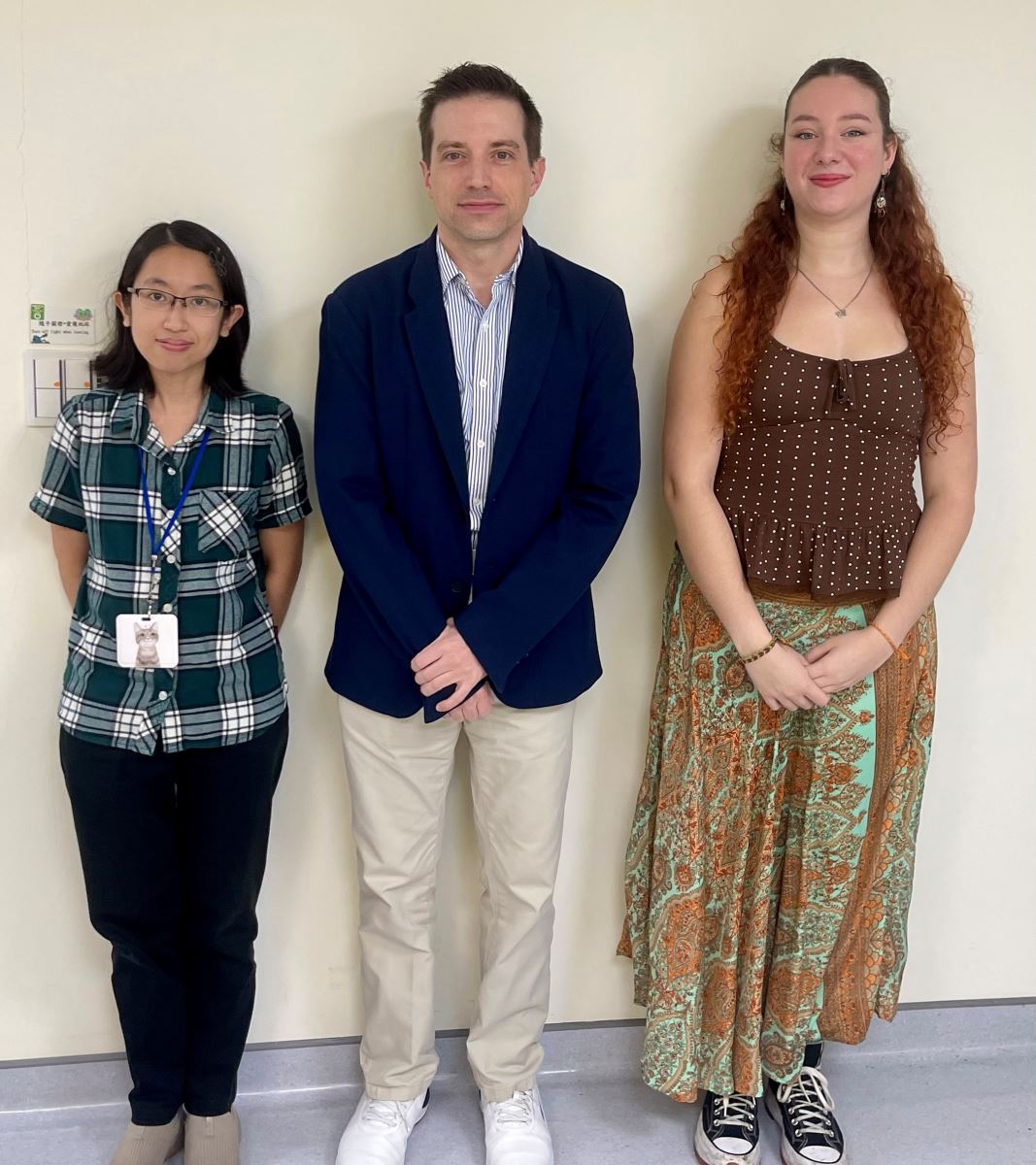
研究團隊:(左:Maria Lucia Veronica Theja碩士生 中:Lucas A. Lane助理教授,右:Maud Gacquer碩士生
Research Team: (Left: Maria Lucia Veronica Theja, Master's student; Middle: Lucas A. Lane, Assistant Professor; Right: Maud Gacquer, Master's student)